The Anatomy of Shipping Software to Perfection: How Code Review Caught What Tests Couldn't
Across the GeekBye v2 series, the same thing keeps happening: a fix passes every test on the developer's machine, and then code review proves it would have failed for almost everyone. This is the workflow behind nine releases — the review gate, the fix-first catches, and the test-before-ship discipline that turns "it works for me" into "it works."
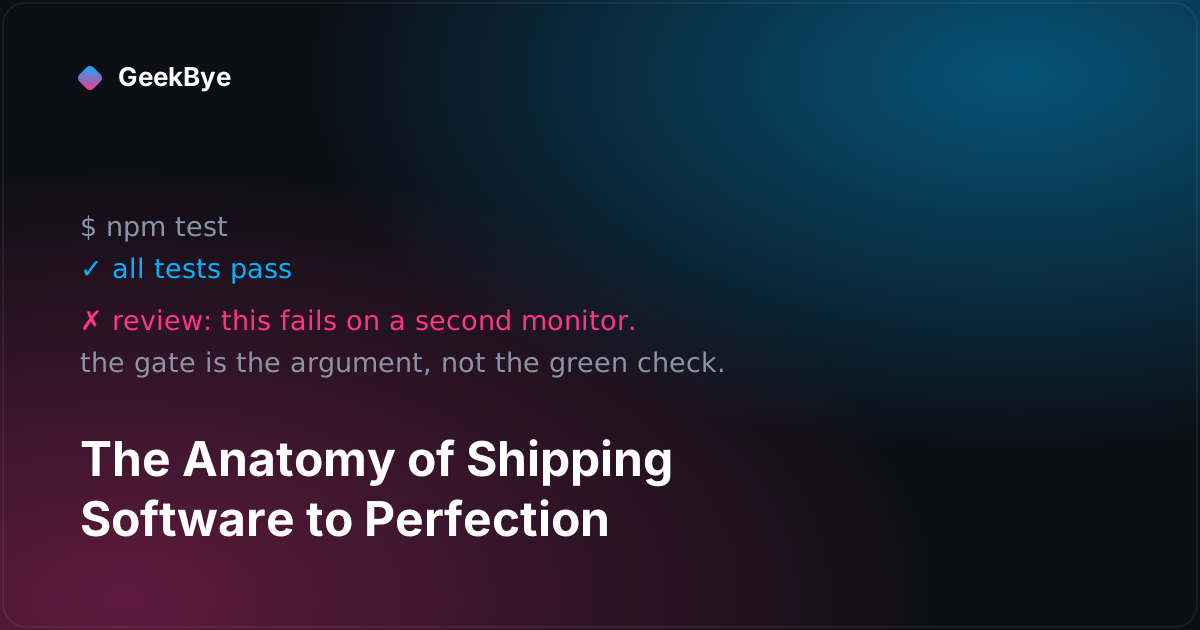
Over a couple of weeks, GeekBye shipped nine releases — v2.0.0 through v2.0.11 — and this series told the story of each one. Read them together and a pattern jumps out that's more interesting than any single bug: again and again, a fix passed every test on the developer's machine, and code review proved it would have failed for almost everyone else.
That gap — between "it works for me" and "it works" — is where reliability actually lives. This is the workflow that closes it, and the index to every release it produced.
The pattern: green tests, wrong answer
Here are three of the clearest cases from the series, because they make the abstract concrete.
- In the multi-monitor capture fix (v2.0.10), the first implementation anchored screen capture on the app's overlay window. It passed testing — on a single-monitor dev machine. Review reasoned about where that overlay actually lives (the primary display, always, unless you physically drag it) and proved the "fix" would have resolved right back to the wrong monitor for nearly every real user. The correct anchor — the cursor — came out of that argument, not out of a test run.
- In the WebSocket-fallback release (v2.0.8), review found that the exact
403a blocking proxy returns was classified as a fatal auth error — so the fallback the feature existed to trigger could never fire. The feature would have shipped, passed its happy-path tests, and done nothing for its actual audience. - In the idle-timeout fix (v2.0.9), the first version stamped the "still alive" clock inside a code path that a subset of transcripts legitimately skip — the other speaker's. Review caught that a future change could silently reintroduce the exact bug being fixed, and the stamp was moved somewhere unconditional, with a test to keep it there.
None of these were caught by running the code. All of them were caught by a reviewer reasoning about why the code works — and finding a case where it doesn't.
The three parts of the gate
The workflow behind the series is not elaborate. It's three habits applied without exception.
1. Review reasons about correctness, not just runs the code. A passing test proves the code works for the case you thought of. Review is a second, adversarial model of the system asking what case did you not think of? — the second monitor, the corporate proxy, the transcript that skips the branch, the client that's one version behind. The review step in this series was frequently an independent agent reviewer prompted to refute the fix, not bless it. That framing is the whole point: a reviewer trying to break your reasoning finds the hole a reviewer trying to approve it skims past.
2. Every behavior fix ships with a test that pins the exact failure. Not a test that the feature works — a test that this specific bug is dead. The blocked-proxy 403 must fall through to the fallback; a real auth 403 must not. The activity clock must stamp on a transcript that skips attribution. These tests exist so the bug can't quietly return in six months when someone refactors nearby — the failure is nailed to the floor.
3. The build is notarized and verified before it ships. Several of these fixes went from diagnosis to a signed, notarized, auto-updating release within a day. That speed is only safe because the gate is disciplined: the diagnostic proves the root cause (the microphone-permission release shipped its diagnostic first), the test pins the fix, review refutes the reasoning, and only then does a real notarized build go out. Rigor is what makes speed safe, not what trades against it.
Why this matters more for an AI app
There's a reason this discipline is non-negotiable for a tool like GeekBye specifically. Several of the nastiest bugs in the series were silent-wrong, not crash-loud: a screenshot that fed the wrong monitor to the AI (v2.0.10), a transcription biased toward junk terms so "speak" came out as a name (v2.0.11), an assistant answering in the wrong mode with no way to see it (v2.0.3 + v2.0.5). When your app feeds context to a model, a wrong input produces a confidently wrong output and no error anywhere. You can't test your way out of failures that don't throw. You have to reason your way out — which is exactly what the review gate is for.
The series, in order
Each of these is a self-contained case study in one release. Read start to finish, they're the anatomy of taking a product from "works" to "trustworthy."
- What a version 2 actually takes: 206 commits of honest states — v2.0.0. The foundation: never show a state that isn't true.
- The day our app DDoSed itself — v2.0.1 + v2.0.4. A startup upload backlog stampeding our own backend, and the liveness ladder it forced.
- Calm software: the flicker fix and the answer-mode chip — v2.0.3 + v2.0.5. No-feature releases that bought trust one detail at a time.
- Your Mac app forgets microphone access every launch — v2.0.6. macOS App Translocation, and shipping the diagnostic before the fix.
- One CSS variable, five review rounds, and a Swift toolchain that lied — v2.0.7. Uniform translucency, and a binary that changed size because the docs disagreed with the enforcement script.
- Live transcription when the firewall blocks WebSockets — v2.0.8. A pure-HTTPS fallback, and the
403that would have hidden it from itself. - Why your AI notetaker stops recording mid-meeting — v2.0.9. An idle timer that could only hear you, and a crash that could lock your desktop.
- Why screen recording captures the wrong monitor — v2.0.10. The wrong-display bug, and the fix that passed on one monitor and would have failed on two.
- Why AI transcription mishears technical terms — v2.0.11. Biasing speech toward your vocabulary — and the regression that made it worse before it made it better.
The takeaway
Perfection isn't a state you reach; it's a gate you keep. Nine releases, and the same three questions at every one: what case did you not think of, is the exact failure pinned by a test, and did a real signed build actually go out? None of it is glamorous. All of it is why GeekBye v2 feels calm. If you build software — AI or otherwise — the transferable part isn't any single fix. It's the habit of treating a green test suite as the start of the argument, not the end of it.
Every release above is live via auto-update — a feature that was itself one of the hardest things we ever shipped, told in the safety check that made our app impossible to quit (the v1 era that led here). For the product these fixes add up to, see what's new in GeekBye v2.