Caveman Claude Skill: Fewer Tokens, Same Answers
Caveman Claude: an Apache-2.0 licensed skill that makes Claude Code answer in caveman prose to save tokens. README claims 65% fewer; JetBrains measured 8.5%.
Verified September 24, 2026: skill names, install commands, licences and the benchmark figures below were read from the Caveman repository at revision 2fd153c (release v2.7.0, September 15, 2026), from the JetBrains test write-up and from the CAVEWOMAN paper on arXiv. Star counts come from the GitHub API on the same day. Caveman 3.0.0, released the same day, relicensed the whole repository to Apache-2.0; the licence statements below were updated on November 2, 2026 to reflect it.
Caveman Claude is Claude Code running Caveman, an Apache-2.0 licensed skill by Julius Brussee that makes a coding agent answer like a caveman — no articles, no filler, no hedging — while code, commands, file paths and exact error messages stay untouched. It started as a joke in April 2026 and had 107,621 GitHub stars on September 24, 2026, sixth in the catalogue of skill repositories we maintain.
| Caveman at a glance | |
|---|---|
| Repository | github.com/JuliusBrussee/caveman |
| Author | Julius Brussee |
| Licence | Apache-2.0 for the whole repository since Caveman 3.0.0 (previously MIT skill, BSL-1.1 engine) |
| Stars | 107,621 (GitHub API, September 24, 2026) |
| Latest release | v2.7.0, September 15, 2026 |
| Agents supported | Claude Code, Codex, Gemini CLI, Cursor, Windsurf, Cline, Copilot and 30+ more by the README's list |
| Flagship skill | caveman, with lite, full (default), ultra and three wenyan levels |
| One-line install | npx skills add JuliusBrussee/caveman -g |
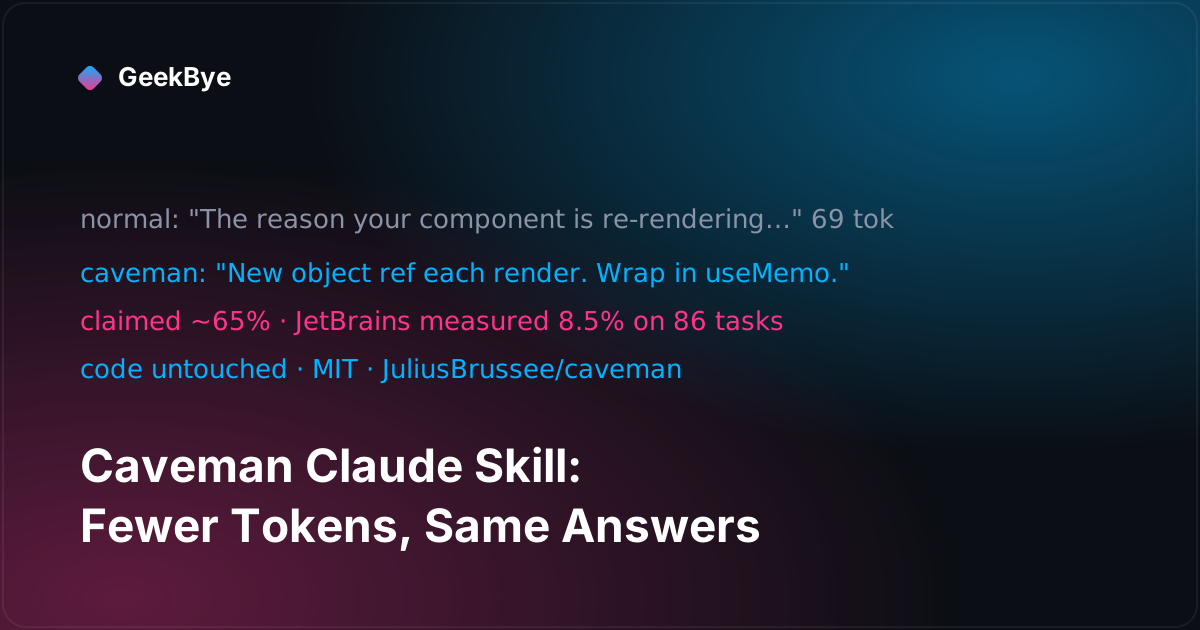
The pitch fits in one line of the README: "why use many token when few do trick." The same question asked twice shows it. A normal agent spends 69 tokens explaining a React re-render; the caveman agent says "New object ref each render. Inline object prop = new ref = re-render. Wrap in useMemo." in 19. Same diagnosis, same fix.
Who uses it, and for what. Developers who read their agent's replies all day and pay per token: people running Claude Code or Codex through long sessions, reviewing answers rather than pasting them somewhere. Caveman is used for conversation — explanations, diagnoses, status updates, review notes — and not for the code the agent writes, which it leaves alone by design.
What the caveman skill actually does
Caveman is one rule file with a persona. The agent is told to drop articles, filler words, pleasantries and hedging, to prefer fragments and short synonyms, and to keep every technical term exact. Three things are explicitly off limits:
- Code and literals. Code blocks, commands, API names, file paths and error strings are never rewritten.
- Safety text. Security warnings and confirmations for irreversible actions switch back to full sentences, then caveman resumes.
- Anything that outlives the chat. Commit messages, PR descriptions, code comments and documentation are written in normal prose.
The persona is doing real work. "Be concise" is an abstract instruction a model drifts away from within a few turns; "talk like a caveman" is a character, and a character is easier to hold.
| Level | Same question: "Why does my React component re-render?" |
|---|---|
lite |
Your component re-renders because you create a new object reference each render. Wrap it in useMemo. |
full |
New object ref each render. Inline object prop = new ref = re-render. Wrap in useMemo. |
ultra |
Inline obj prop, new ref, re-render. useMemo. |
wenyan |
The same answer compressed into classical Chinese, at three intensities |
Switch caveman mode in Claude with /caveman lite, /caveman ultra and so on; stop caveman or normal mode turns it off.
How much does Caveman reduce Claude Code token usage?
If your goal is to reduce Claude Code token usage, the honest answer is somewhere between 65% and 8.5%, depending on what the agent spends its tokens on. The repository's description says Caveman "cuts 65% of tokens". Three independent measurements say how much of that survives real work — and to the maintainer's credit, the README now quotes the smaller numbers itself.
| Who measured | What they measured | Result |
|---|---|---|
| Caveman's own eval | Ten developer questions, skill vs an "Answer concisely." control | 50% fewer output tokens at the median, on top of the terse control. Length only, not correctness |
| JetBrains | 86 real coding tasks, paired A/B, Claude Code 2.1.200, about 240 billed trials | 8.5% fewer output tokens, about 10% of cost at best. 8 tasks better, 10 worse, 64 tied, p = 0.82 |
| Adobe Research, CAVEWOMAN | Eight models, five datasets, output and input compression | Compressing output cut realized cost 1.4 to 2.4× per model, up to 3×. Compressing the prompt raised cost |
The gap is not a contradiction. On a chat-style question almost every output token is prose, so cutting prose cuts most of the bill. In an agentic coding session most output tokens are code, diffs and tool calls, which Caveman deliberately leaves alone — so the prose it can touch is a small share of the total. JetBrains' author, Denis Shiryaev, summed it up as "safe, honest about style, oversold on savings."
The Adobe finding matters for how you use it. The CAVEWOMAN paper found that compressing the human's prompt made models answer longer and less accurately, raising net cost by about 1.15× on average. Caveman only changes how the agent talks. Keep writing your own prompts in full sentences.
Skill, proxy, or both
Caveman is now two products in one repository, both Apache-2.0 since Caveman 3.0.0.
- The skill (no account, no network) shrinks what the agent writes. This is the part most people mean by "caveman mode".
- The proxy runs locally between the agent and the provider and shrinks what the agent reads: logs, test output, JSON, diffs. The README reports a pinned 54-run Claude Code benchmark with 33.2% fewer input tokens and 18 of 18 answers correct — a maintainer-run report whose raw artefacts are not yet published.
The proxy exists because of the JetBrains result: an agent's bill is mostly reading, and no talking style fixes that. If you only want the voice, install the skill and stop there. The CLI sends anonymous usage counts by default; caveman telemetry off or DO_NOT_TRACK=1 disables it. The skill and its hooks send nothing.
The rest of the toolbox
| Skill | What it does |
|---|---|
caveman-commit |
One-line Conventional Commit messages |
caveman-review |
Code review as one finding per line: L42: 🔴 null deref. Guard it. |
caveman-compress |
Rewrites CLAUDE.md-style memory files; 46% smaller on average across five fixtures, backup kept |
caveman-help |
One-screen reference for every mode and command |
caveman-stats |
Recorded token usage for the current Claude Code session |
cavecrew-investigator, cavecrew-builder, cavecrew-reviewer |
Subagent presets whose replies come back compressed, so the main context lasts longer |
caveman-compress is the one that pays on every session rather than every reply: a memory file is re-read on every call, so a smaller one is a permanent input saving. Always read the diff before accepting it.
How to install Caveman in Claude Code
Install the Caveman skill in Claude Code with npx skills add JuliusBrussee/caveman -g; the full installer needs Node.js 22.13 or newer. The project's own commands, read on September 24, 2026:
# Any skills-compatible agent (Claude Code, Codex, Cursor, Windsurf, Cline, ...)
npx skills add JuliusBrussee/caveman -g

# Claude Code plugin (adds the session-start hook)
claude plugin marketplace add JuliusBrussee/caveman && claude plugin install caveman@caveman

# Gemini CLI
gemini extensions install https://github.com/JuliusBrussee/caveman
To use Caveman in Claude Code after installing, type /caveman if it does not switch on by itself. The Caveman plugin for Claude is the route that adds the session-start hook, so the mode comes back in every new session. The full installer needs Node.js 22.13 or newer; uninstall with npx -y github:JuliusBrussee/caveman -- --uninstall.
Our distribution carries pinned, licence-checked copies of the five most-installed Caveman skills — caveman, caveman-commit, caveman-review, caveman-compress and caveman-help — recorded against upstream revision JuliusBrussee/caveman@c2906c6. On September 18, 2026, Skills.sh listed 519.5K installs for caveman alone.
npx skills@1 add aiescu/agent-skills --skill caveman
When to skip it
- Per-request billing. On GitHub Copilot premium requests a shorter answer is the same request, so there is nothing to save.
- Pure code generation. If nearly all output is code, Caveman has almost nothing to cut.
- Short one-liners. The full ruleset rides along as roughly 1,000 input tokens on every call; on terse Q&A that can cost more than it saves.
The honest test is your own: run the same task with and without it and compare the provider's billing page.
How Caveman behaves day to day
Installed as a Claude Code plugin, Caveman's session-start hook turns the default level, full, on at the start of every session; /clear and compaction keep whatever level was last set. Session hooks depend on the agent and on how it is launched, so where hooks do not fire, Caveman stays installed but silent until you type /caveman.
The rule that matters most is the boundary. Chat replies come back clipped, but commit messages, PR descriptions and articles like this one are still written in normal prose, because the skill treats anything persisted as out of scope. A terse agent is easy to live with. A terse git history is not.
Caveman also stacks cleanly with process skills. It runs alongside Superpowers, which decides what the agent does next, while Caveman only decides how many words it uses to tell you. Matt Pocock's skills sit in the same toolbox. The habit underneath all three — asking a fast, confident system for exactly what you need and checking what comes back — is the same one our guide to Claude Code vs Codex and agent literacy covers.
FAQ
What is Caveman in Claude Code?
Caveman is an agent skill by Julius Brussee that makes Claude Code reply in compressed caveman prose — no articles, filler or hedging — while code, commands, paths and error messages stay verbatim. Turn it on with /caveman and off with stop caveman.
Is Caveman free? Yes. Since Caveman 3.0.0 (September 24, 2026) the whole repository — skill, CLI, client SDKs, engine and proxy — is Apache-2.0, and the skill needs no account or API key. Before 3.0.0 the engine and proxy were BSL-1.1, which required a commercial licence to host them for third parties.
Does Caveman work with agents other than Claude Code? Yes. The README lists 30+ skills-compatible agents, including Codex, Gemini CLI, Cursor, Windsurf, Cline and Copilot. The proxy wraps ten agents natively, including Claude Code, Codex, Gemini CLI, Aider and opencode.
Does Caveman change the code the agent writes? No. The skill never shortens code, never paraphrases an error message and never compresses your prompt. It only changes the prose around the code.
Caveman vs Superpowers: what is the difference? Caveman and Superpowers solve different problems. Superpowers controls what a coding agent does next — design, plan, test, verify — while Caveman only controls how many words the agent uses to report it. Both use session-start hooks and can be installed in the same Claude Code session.
Does Caveman send my code anywhere?
No. The Caveman skill and its hooks run locally and send nothing. The optional Caveman CLI sends anonymous usage counts by default — which commands ran and token totals, never prompts, code or file paths — and caveman telemetry off or DO_NOT_TRACK=1 disables it.
How do I turn Caveman off?
Say stop caveman or normal mode for the current session. To stop it starting automatically, remove the plugin or set the default mode to off in the Caveman configuration.
The ten skill collections we use every day
Caveman is sixth in a list of ten that we keep ranked by stars fetched from the GitHub API, never typed by hand. The other nine cover full methodologies, small engineering tools, design taste, answer shape and app automation — the whole ranking is in our guide to the 10 best Claude Code skills on GitHub.
The same repository records the three products we build with those skills: GeekBye, the real-time interview assistant; Keebye, push-to-talk dictation for people who drive coding agents; and Pavleur, an AI meeting copilot for Mac — each with the skills that did the work.
The full list, install commands and licence records: github.com/aiescu/agent-skills, also browsable on the web at aiescu.com/agent-skills. The short video version of the ranking is on YouTube: Top 10 Agent Skills for Claude Code, Cursor & Codex.