Claude Code vs Codex: The Real Skill Is Agent Literacy
Everyone asks which one is better. That's the wrong question. Here's what each tool makes you better at — and the 2026 skill that actually matters: steering, dispatching, and verifying agents.
Everyone is asking the same question right now: Claude Code vs Codex — which one is better? I get it constantly. And I think it is the wrong question.
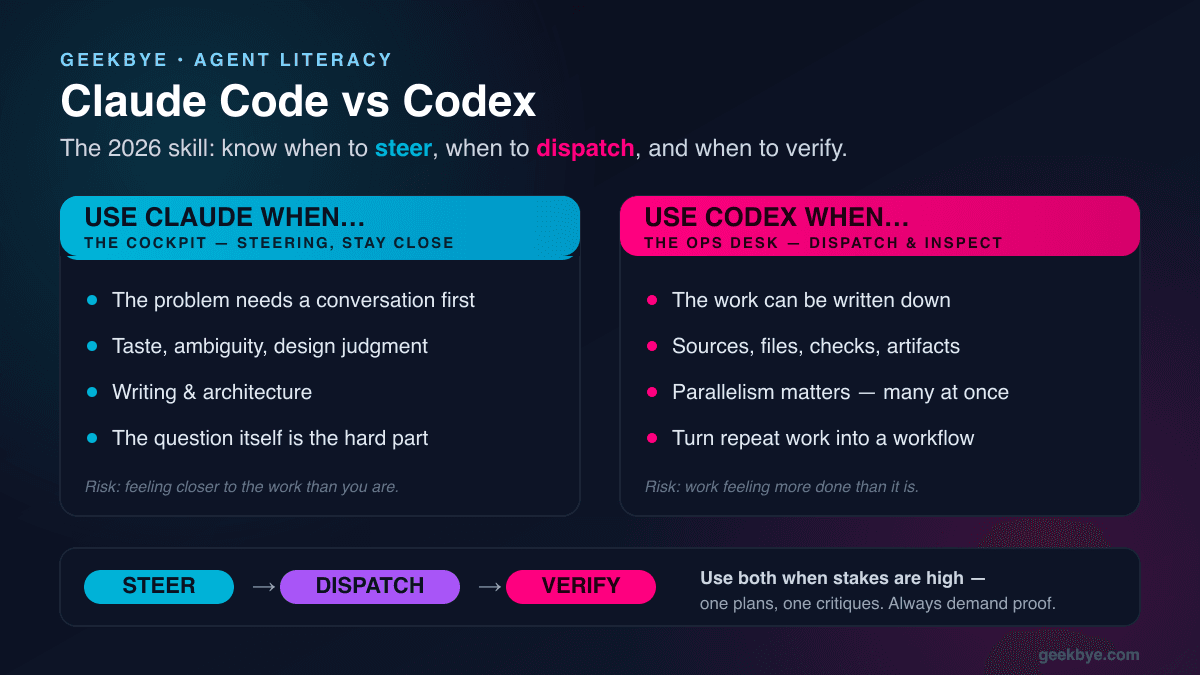
The better question is: what does each tool make you better at doing with agents? Because the skill of 2026 is not picking a winner. It is agent literacy — the ability to hand real work to an AI agent and trust what comes back.
Here is the shorthand, right at the top: Claude Code makes steering agents feel natural. Codex makes dispatching agents feel natural. That difference may matter more than which model tops a benchmark this month, because it is teaching you a habit. And habits are what stick.
This is the Mac vs Windows moment for agents
Not because Claude is Mac and Codex is Windows — that is too cute. The point is that interfaces train behavior. Mac and Windows did not just compete on features; they taught a generation what a computer was for — where work lived, how much the machine should hide or show, how much control you ought to have.
Claude and Codex are doing that now for agents. They are quietly teaching us what an agent is for. And that is why this matters even if you never write a line of code.
Why this isn't just a developer fight
The vocabulary sounds intimidating — work trees, hooks, sandboxes, diffs — so a lot of people assume these tools are not for them. I think that is exactly backwards. This is one of the first AI debates non-technical people should force their way into, because coding agents are where the agent habits we will all use are showing up first.
A chatbot answers. An agent takes a job. That second part — the agent taking the job — is the thing we all have to get fluent at directing. You hand it a folder, a goal, a definition of done, and a boundary of what it is allowed to touch. Then it reads files, runs tools, checks what happened, and comes back with something you can inspect.
That pattern showed up in coding first for one simple reason: code has built-in proof of what good looks like. Does it run, or does it not? Most knowledge work was never that clean. Now the agents are getting good enough that the same loop — assign a task, set a goal, use tools, bring back proof — is spreading into the rest of knowledge work. The coding world is just giving us the vocabulary first.
Translating the jargon
Once you translate the terms, the whole toolset stops being scary. These are just the parts of any serious assignment:
| The scary word | What it actually means |
|---|---|
| Context | The background and files the agent gets to read |
| Permissions | What the agent is allowed to touch |
| Tools / MCP | The helpers it can call (browser, terminal, your apps) |
| Plan mode | Making it think before it acts |
| Hooks | Checks that run automatically |
| Sandbox / work tree | A contained place to work without touching everything else |
| Diff / proof | The receipt that shows what it actually did |
Context, permissions, tools, checkpoints, helpers, and proof. That is just what doing real work looks like.
Claude Code: the cockpit (steering)
Claude Code feels like a cockpit you are flying. You are close to the model. You talk through the work while it happens. You can ask it to read the codebase and tell you what is going on. You can ask it to interview you before it writes the spec. You can stop it, correct it, make it rethink the plan.
That closeness is a real advantage when the hard part is taste. When the work is fuzzy — design judgment, writing, architecture, or just figuring out the actual question — you want the agent close. You can bring it a half-formed version of the problem, something you cannot quite name yet, and work it out together.
Serious Claude users are not just chatting. They use plan mode before edits. They keep a standing project note that says how the project works, the commands, the rules. They wire up hooks so important checks run automatically. They split work across sessions and spin out sub-agents.
The risk: you are assembling a lot of that system yourself. You manage the context window. You decide when to plan, when to add a hook, when to run a workflow. If you are disciplined, it is incredibly powerful. If you are not, the conversation becomes a junk drawer and the context fills up.
Codex: the operations desk (dispatching)
Codex feels different. It feels like an operations desk. One thread reads a folder, another drafts a document, another checks a package, another drives a browser — all at the same time. The work queue is visible. Jobs stay separated. The outputs are easy to inspect.
That changes what you are willing to hand over. With Codex you still ask for help thinking, but far more often you say: go do this piece, bring back the results, and show me the proof. For software that proof is a diff, a test output, a pull request. For knowledge work it might be a source list, a rendered document, or a comparison table. The sandbox means the agent has a contained place to try things, and background automations mean it can wake up and run later without you watching.
Stacked together, that is a way of making agent labor easy to manage — to delegate, separate, and verify.
The risk: a completed run can make work feel more done than it really is. The agent comes back and says "task complete," and on the surface every signal of progress is there. But maybe it followed the instruction too literally, optimized for completeness over quality, or produced a pile that takes longer to review than the task would have taken to do yourself.
The decision rule
So which do you reach for? A practical rule:
- Use Claude when the problem needs a conversation before it can become an assignment — taste, ambiguity, design judgment, writing, architecture. When the shape of the question is the hard part.
- Use Codex when the work can be written down and delegated — when there are sources, files, tools, checks, and artifacts to call in; when parallelism matters; when a repeated task should become a durable workflow instead of one helpful exchange.
- Use both when the stakes are high. Let one model plan and the other critique. Let one implement and the other review. Let one produce the artifact and another inspect it against the standard.
And be careful which failure mode you are training. Claude can seduce you with a great conversation and make you feel closer to the work than you are. Codex can persuade you a workflow is finished when it is not. Both still require judgment. Both still require proof.
The part that can't be skipped — and where GeekBye fits
Here is the honest center of all this: you do not disappear in the agent age. You move to the part of the work that cannot be skipped — deciding what work should exist, what "done" means, what risks matter, what proof counts, and when the output is ready to leave the machine.
That same judgment is now showing up in the room where careers are decided. Technical interviews increasingly probe how you work with AI agents — not just whether you can write an algorithm from a blank page. Whichever tool you prefer, the meta-skill is identical: steer, dispatch, verify.
This is where GeekBye earns its place. It is the on-device assistant that helps you apply that judgment live:
- Real-time help and transcription, so you can think clearly under pressure instead of freezing — the Listen feature captures both sides of the conversation as it happens.
- Private by design. Screenshots are processed by on-device OCR and your library stays on your machine — your receipts, not someone else's server.
- Invisible during screen-shares, using OS-level capture protection rather than a browser trick.
- Proof you can learn from afterward. Every session leaves a summary, key points, and performance metrics so each interview sharpens the next.
If you are preparing for engineering roles, agent literacy is the interview now — and our guide to technical interviews with GeekBye walks through how to show it.
FAQ
Is this only for developers? No. Coding agents are simply where the habits arrived first, because code has built-in proof. The same loop — assign, set a goal, use tools, demand proof — already applies to research, writing, and operations work.
Which should I start with, Claude Code or Codex? Start with the one that matches your bottleneck. If your hard part is thinking through fuzzy problems, start with Claude (steering). If your bottleneck is moving and verifying a lot of well-defined work, start with Codex (dispatching).
What is agent literacy, exactly? The skill of writing assignments that come back as inspected work: knowing when to steer, when to dispatch, and when to verify — and never trusting an agent just because it sounds confident.
Do I have to pick one? No. The strongest users run both and let them check each other — one plans, one critiques; one builds, one reviews.
The bottom line
Do not reduce Claude Code vs Codex to a coding-tool debate, or even a Mac vs Windows debate. Watch what each tool makes it easier for you to imagine — and what it makes it easier for you to forget. Claude keeps the agent close while the work is still becoming clear. Codex makes agent work feel assignable, parallel, and inspectable. The best operators use both.
The most important question is not which agent is smarter. It is: what work am I now capable of running, and what proof would make me trust it? Answer that, build the habit, and you are already ahead.