Jev AI vs ChatGPT: When to Use TypeSafe's System One Model (and When Not To)
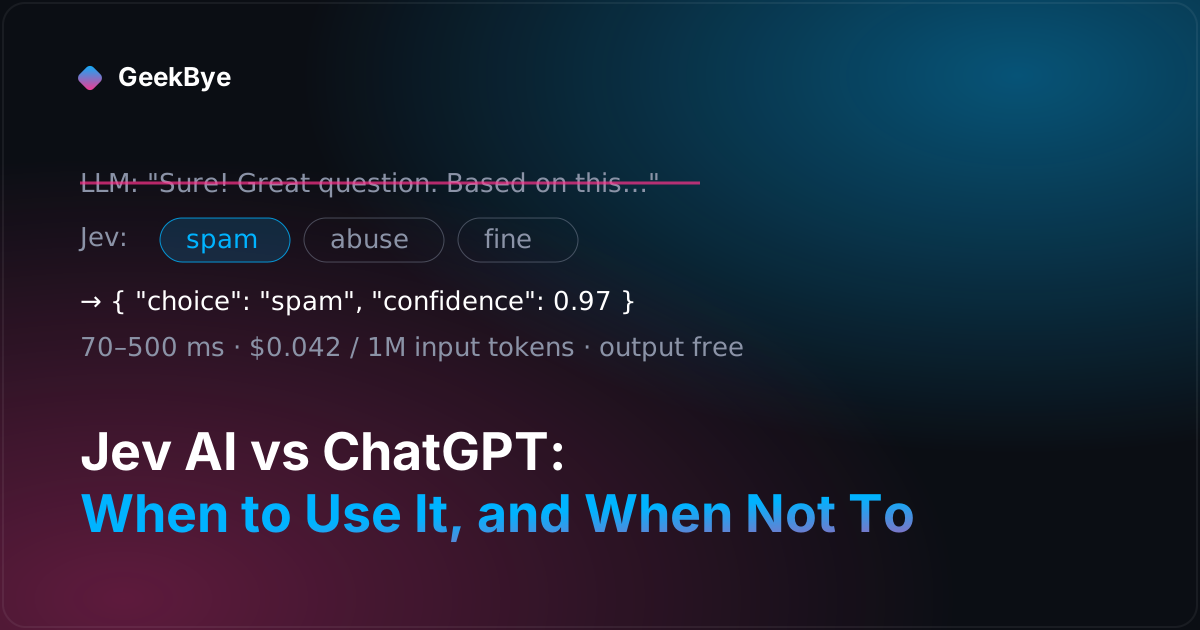
Jev AI is TypeSafe AI's System One model: it does not write text, it returns typed decisions — a choice, a score or a yes/no probability — in 70 to 500 milliseconds. Here is when it beats ChatGPT, GPT or Gemini, when it cannot help at all, and what a million decisions actually cost.
Verified September 21, 2026: model behaviour, question types, limits and example payloads were read from TypeSafe's launch post, the Cloudflare Workers AI model page, the Pydantic AI and LiteLLM integration docs, and the Wikipedia article on Jev. Speed and cost multiples are TypeSafe's own figures. Search-demand data comes from DataForSEO (Google and YouTube, United States, September 21, 2026).
Jev AI is TypeSafe AI's first System One model: instead of generating text, it takes a piece of state and typed questions and returns a choice, a score or a yes/no probability, each with a calibrated confidence. TypeSafe describes it as "a frontier-intelligence function call: unstructured state in, typed probabilistic decisions out." It was released in limited early access on September 15, 2026.
| Jev AI at a glance | |
|---|---|
| Developer | TypeSafe AI, San Francisco, founded 2024 |
| Founder and CEO | Diogo Almeida, formerly at OpenAI (RLHF, InstructGPT, ChatGPT, GPT-4) |
| Released | September 15, 2026, limited early access |
| Model class | System One model (not an LLM) |
| Question types | Choice, Score, Noul (yes/no probability) |
| Response time | 70–500 ms end to end (TypeSafe) |
| Price | $0.042 per million input tokens; output tokens free |
| Context | 32k tokens of state; 64k for state and questions together |
| Training method | Reinforcement Learning for Calibrated Decisions (RLCD) |
| Model names | jev-1.13.0, jev-latest, jev-preview |
| Available through | TypeSafe API, Cloudflare Workers AI, Pydantic AI, LiteLLM |
What is Jev AI?
A large language model answers by writing, one token at a time. Jev answers by deciding. You pass it the thing being judged — a support ticket, a comment, a transaction, an agent's last step — and one or more typed questions. It returns one typed answer per question, with probabilities attached.
TypeSafe calls this class of model System One, after the fast, intuitive mode of thinking: the judgement a knowledgeable person makes in a second, not the essay they would write about it. The Pydantic AI docs put the design rule plainly: "the prompt is only what is being judged, and the question belongs on the output type."
The name has nothing to do with an acronym. According to Wikipedia, Jev is named after the economist William Stanley Jevons and the Jevons paradox — the expectation that making decisions cheaper will make software use far more of them.
The three question types: Choice, Score and Noul
Every Jev question is one of three primitives, as documented by Cloudflare and Wikipedia:
| Type | What it answers | What comes back | Example |
|---|---|---|---|
| Choice | Which of these options fits? | The selected option, per-option probabilities, a confidence | Route a ticket to billing, technical or sales |
| Score | Where does this sit on my rubric? | A level, per-level probabilities, a confidence | Rate the severity of a bug report 0–2 |
| Noul | Yes or no? | A probability between 0 and 1 | Is this transaction fraudulent? |
This is the example from the LiteLLM integration docs, a ticket routed by a Choice question:
{
  "state": "Help! My payouts have been failing for 3 days.",
  "model": "jev-latest",
  "questions": {
    "department": {
      "type": "choice",
      "instructions": "Which team should handle this?",
      "criteria": {
        "billing": "Payments, invoicing, refunds",
        "technical": "Bugs, outages, integrations",
        "sales": "Pricing, upgrades, new accounts"
      }
    }
  }
}
And the response:
{
  "model": "jev-1.13.0",
  "answers": {
    "department": {
      "type": "choice",
      "choice": "technical",
      "probabilities": { "billing": 0.08, "technical": 0.85, "sales": 0.07 },
      "confidence": 0.82
    }
  },
  "usage": { "input_tokens": 312, "output_tokens": 48 }
}
There is nothing to parse. The answer can only be one of the three keys you defined, so there is no broken JSON, no conversational filler and no invented fourth department. TypeSafe states that type-safety is guaranteed by construction and that Jev "can't hallucinate" an answer outside the schema.
Jev AI vs ChatGPT, GPT and Gemini
Jev is not a smaller ChatGPT. It is a different tool for a different part of the pipeline.
| Criteria | Jev AI | ChatGPT, GPT, Gemini and other LLMs |
|---|---|---|
| Output | A typed decision with probabilities | Free text, generated token by token |
| Response time (TypeSafe) | 70–500 ms | 3–329 seconds on the same System One tasks |
| Input price (TypeSafe) | $0.042 per million tokens | $0.20 to $10 per million tokens |
| Output price | Free | About 5x the input price, per TypeSafe's comparison |
| Off-schema answers | Impossible by construction | Possible; needs parsing, validation and retries |
| Confidence | Calibrated probability on every answer | Not native; must be prompted or estimated |
| Writes email, code, chat | No | Yes |
| Reads images, audio, PDFs | No | Depends on the model |
TypeSafe benchmarked Jev against GPT-5.6 Terra, GPT-6 Astra and Fable 5.1 on what it calls System One tasks, and reports Jev as 40x to 200x faster at comparable accuracy. Its best workflow result — 193.6x faster and 444.6x cheaper — is one the company itself describes as likely "the high end of real-world results." Treat the multiples as a vendor claim and measure on your own data before you migrate anything.
When to use Jev AI
Use Jev when the answer to your question is a label, a score or a yes/no, and you ask it often enough for speed and cost to matter.
- Routing support tickets to the right team or queue.
- Moderating comments as spam, abuse or fine, on every write.
- Fraud and risk checks that need a probability, not a paragraph.
- Checking what an AI agent did — did the step succeed, should it retry, is the output on-policy.
- Branching inside automations: which workflow path, which template, which priority.
- Scoring against a rubric: severity, urgency, lead quality, relevance for reranking.
The common thread: the decision is small, it happens thousands or millions of times, and today it is either a brittle regex or an LLM call you parse and retry.
When not to use Jev AI
- Anything that needs words. Jev cannot write an email, write code or hold a conversation.
- Open-ended reasoning. If you cannot list the possible answers in advance, it is not a Jev question.
- Non-text input. The Pydantic AI docs list images, audio, video and documents as unsupported.
- Huge option sets. A single Choice question accepts at most 255 options.
- Long context. State is capped at 32k tokens, and state plus questions at 64k.
- Compound questions. Each field should be one judgement. Split "is this urgent and is it about billing" into two questions.
What a million decisions cost: a worked example
Jev's pricing is simple enough to calculate by hand. Take the ticket above: 312 input tokens.
| Scenario: 1,000,000 tickets × 312 input tokens = 312M input tokens | Input cost | Output cost |
|---|---|---|
| Jev at $0.042 per million input tokens | $13.10 | $0 (free) |
| LLM at $0.20 per million input tokens (TypeSafe's low end) | $62.40 | extra, billed per token |
| LLM at $10 per million input tokens (TypeSafe's high end) | $3,120 | extra, billed per token |
The LLM rows count input only. An LLM also bills every output token it writes — and, per TypeSafe, output tokens cost about five times as much as input — so the real gap is wider than the table shows. To run your own numbers, multiply your average input tokens per decision by your monthly volume, divide by one million, and multiply by $0.042.
How to call the Jev AI API
Jev is not called through a chat completions endpoint. It has its own decision endpoint, and the integrations wrap it:
- TypeSafe API. Keys are issued from the console at
console.typesafe.ai; the base URL ishttps://api.typesafe.ai, and the key goes inTYPESAFE_API_KEY. - Pydantic AI.
pip install "pydantic-ai-slim[typesafe]", then declare your questions as typed fields:boolfor yes/no,LiteralorEnumfor a choice, a boundedfloatfor a probability,IntEnumwith docstrings for a rubric. - LiteLLM. Pass-through at
/typesafe/v1/systemone, with model namesjev-1.13.0,jev-latestandjev-preview. - Cloudflare Workers AI. Listed as
typesafe/jev, with pricing in the Cloudflare dashboard.
Access is still limited early access, so check the console for availability before you plan a migration.
The rule of thumb
Keep the LLM for the complicated reasoning. Hand the millions of tiny decisions that follow it to Jev.
That split — one expensive, slow, thoughtful step and many cheap, instant, typed ones — is the whole idea. It is the same distinction people make every day between thinking something through and making a quick call, and the skill of knowing which one a moment needs is not unique to software. Our guide to technical interviews with GeekBye covers the human version of it: answering fast when the answer is a call, and slowing down when it needs reasoning.
FAQ
What is Jev AI? Jev AI is a System One model from TypeSafe AI, released in limited early access on September 15, 2026. It does not generate text. It answers typed questions about a piece of state — as a Choice, a Score or a Noul (yes/no probability) — with a calibrated confidence, in 70 to 500 milliseconds according to TypeSafe.
What is TypeSafe AI? TypeSafe AI is a San Francisco AI lab founded in 2024 by Diogo Almeida, Erik Gafni and Sasha Sheng. It builds what it calls machine-native intelligence for automation: models that make decisions inside software rather than write for people. Jev is its first model.
Is Jev AI an LLM? No. Jev is transformer-based, but it is not a large language model: it never writes text. It returns typed values with probabilities, which is why TypeSafe describes it as a new model class, the System One model.
What does Jev stand for? It is not an acronym. Jev is named after the economist William Stanley Jevons and the Jevons paradox: when a resource gets cheaper, people use far more of it.
How much does Jev AI cost? TypeSafe prices Jev at $0.042 per million input tokens, and output tokens are free. One million support tickets of about 312 tokens each cost about $13.10 in input.
Is Jev AI better than ChatGPT? For typed decisions — routing, labelling, scoring, yes/no checks — TypeSafe reports Jev as 40x to 200x faster and far cheaper than frontier LLMs at comparable accuracy. For writing, coding, chat or open-ended reasoning, Jev cannot help at all, and ChatGPT, GPT or Gemini remain the right tool.
Can Jev AI hallucinate? Not outside your schema. A Jev answer can only be one of the options, levels or probabilities you defined, so it cannot invent a fourth option or return malformed output. It can still be wrong within your options, which is what its confidence score is for.
How do I get a Jev AI API key?
Jev is in limited early access. API keys are issued from the TypeSafe console at console.typesafe.ai, and Jev is also reachable through Cloudflare Workers AI, Pydantic AI and LiteLLM.
Sources
- TypeSafe AI, Introducing System One Models and Jev
- Cloudflare, Jev (typesafe) — Workers AI model page
- Pydantic, TypeSafe (Jev) — Pydantic AI docs
- LiteLLM, TypeSafe AI (Jev) pass-through
- Wikipedia, Jev (AI model)
- InfoWorld, TypeSafe AI's new models work with machines, not humans