Best Superpowers Alternatives: Choose by Workflow Gap
Five alternatives to Superpowers compared by control, project context, quality gates, reusable learning and specialized tasks.
The best Superpowers alternative depends on why you want to replace it. Choose Matt Pocock’s skills for selectable engineering procedures, Addy Osmani’s Agent Skills for explicit quality gates, Compound Engineering for retaining project lessons, or GSD Core for phased project coordination. Anthropic’s skills are worth considering when the missing capability is a specialized task rather than a development methodology.
This is a documentation-based shortlist checked November 6, 2026, not a measured ranking. “Best” means a reasoned fit for the use case below. We have not run identical tasks through these projects or measured their costs.
Start with the reason for switching
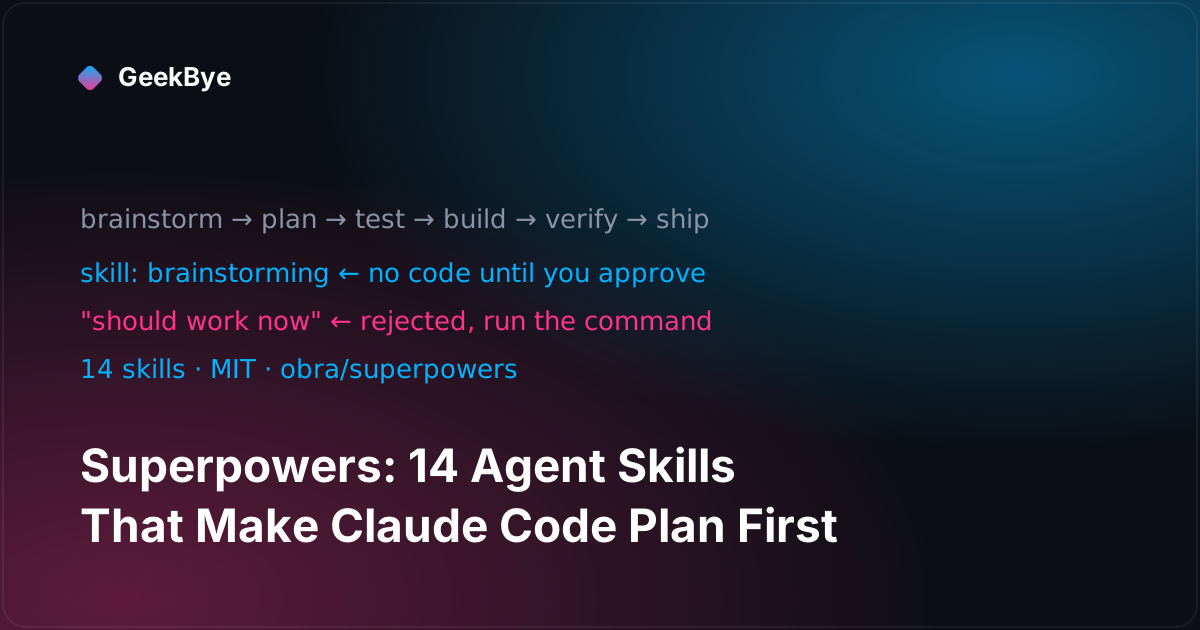
Superpowers connects requirements, planning, implementation, testing and review. Its automatic skill triggering is useful when an agent repeatedly skips engineering steps. Replacing it makes sense when you need different control over that process or a capability it does not emphasize. Source: Superpowers workflow.
Identify whether the failure is redundant questions, forgotten state, repeated mistakes or a missing specialized capability. Each calls for a different solution.
Our Superpowers overview explains the original lifecycle. The shortlist here focuses on replacement criteria rather than repeating a skill catalog.
| Alternative | Best reason to evaluate it | Tradeoff to examine |
|---|---|---|
| Matt Pocock skills | Select procedures around an existing workflow | You choose orchestration and project setup |
| Addy Osmani Agent Skills | Make engineering constraints and domain checks explicit | Host integrations expose commands differently |
| Compound Engineering | Carry verified lessons into subsequent changes | Retained guidance needs maintenance |
| GSD Core | Coordinate milestones, phases and context across sessions | More project artifacts and lifecycle conventions |
| Anthropic skills | Add a specific capability such as document work | Not a replacement development lifecycle |
1. Matt Pocock skills: choose your procedures
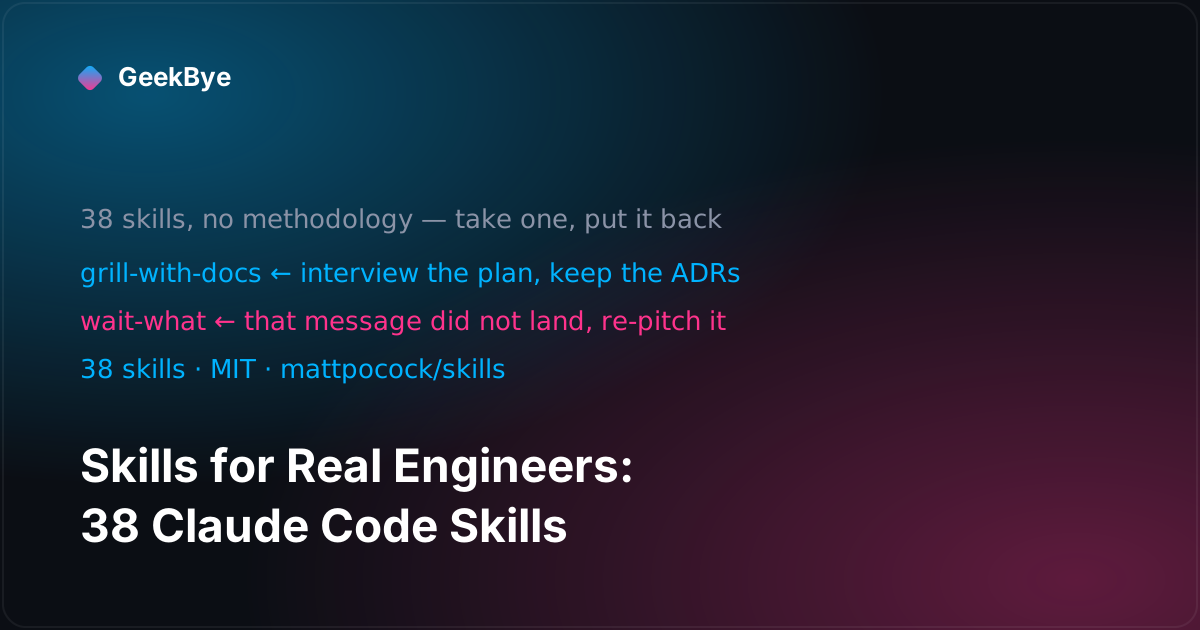
Matt Pocock’s repository describes small, adaptable skills rather than a process that takes control of your engineering work. Its current reference separates user-invoked orchestration from model-invoked reusable disciplines. That means you can choose a grilling or implementation entry point while still letting the agent reach for practices such as TDD and domain modeling. Source: pinned README.
Evaluate it if you already have issue templates, review expectations and a release process. grill-with-docs sharpens terminology and records decisions; to-spec synthesizes an existing conversation; implement-spec can work through a whole specification’s ticket graph. It is not limited to isolated micro-skills or tiny changes.
The tradeoff is selection. Someone must decide when a conversation is ready to become a spec and which flow should execute it. The setup skill configures issue tracking, labels and document locations. If you want the agent to choose a connected lifecycle automatically from the first request, compare that responsibility carefully. Our Superpowers vs Matt Pocock comparison examines this distinction in detail.
2. Addy Osmani Agent Skills: define the quality bar
Addy Osmani’s collection exposes lifecycle commands for specifications, planning, building, testing, review and shipping. It also includes engineering disciplines for API design, frontend work, security, performance and observability. Its constraint-driven-development procedure captures a project’s quality bar in CONSTRAINTS.md. Source: pinned README.
Evaluate it when “the tests pass” does not capture your definition of done. A web feature may also need accessibility checks, a performance budget and explicit API behavior. Written constraints give the agent and reviewer a concrete standard to inspect.
This is another opinionated engineering collection. Check your host’s integration: command wrappers differ, and partial installations can omit shared reference checklists.
3. Compound Engineering: preserve the lesson
Every’s Compound Engineering documents a loop of brainstorming, planning, work, simplification, review and compounding. The last step records reusable learning in docs/solutions/ by default, where later planning can find it. Artifact locations are configurable. Source: pinned README.
Evaluate it when the agent keeps rediscovering the same repository trap. For example, a background job may require an idempotency rule that several past fixes have overlooked. Capturing the explanation and evidence gives the next change a place to start.
The difference is emphasis, not the absence of planning or review elsewhere. Superpowers also creates durable artifacts. Compound Engineering makes the return from completed work into future work a named stage of its loop.
Retained notes can become wrong as systems change. Plan for someone to revise or remove obsolete guidance. Also inspect autonomous routes before adopting them: the README describes an end-to-end mode that can commit, push and open a PR when a remote exists. Choose a workflow consistent with your team’s authorization rules.
4. GSD Core: coordinate work across phases
There is a current naming and source change to resolve first. The gsd-build/get-shit-done README says the repository is no longer the active development home and points to open-gsd/gsd-core. Use the successor’s documentation when evaluating current GSD behavior. Sources: migration notice, GSD Core.
GSD Core organizes milestones through discuss, plan, execute, verify and ship phases. It describes fresh-context subagents for heavy research, planning and execution, with structured state that survives session boundaries.
Evaluate it when the hard problem is coordinating a project too large for one conversation: dependencies, resumed sessions, phase status and handoffs. Do not switch solely because your current agent writes a weak unit test; a project framework adds coordination conventions that may not address that narrower gap. Our GSD vs Superpowers guide separates lifecycle management from engineering procedure.
5. Anthropic skills: fill a specialized capability gap
Anthropic’s repository contains self-contained skills for creative, technical, enterprise and document tasks. It demonstrates how a skill can bundle instructions, scripts and resources rather than only a prompt. The README explicitly presents these as examples and advises testing them in your environment. Source: pinned README.
Evaluate an individual skill when your development agent needs a capability such as inspecting a PDF or generating a presentation. That may solve your actual problem while leaving the existing code workflow intact.
This is an adjacent option, not a like-for-like lifecycle replacement. Also inspect licensing per skill: the README distinguishes many Apache 2.0 examples from source-available document skills. A repository containing skills is not evidence that every directory shares one license.
Worked example: choosing for a background-job change
This scenario is illustrative; it is not a test result. Suppose you need retry behavior for a report-generation job.
If the unresolved issue is what “retry” means to users, start with a requirements interview or domain-modeling procedure. Matt’s collection is a candidate. If the team needs explicit reliability and observability checks, inspect Addy’s constraints and engineering procedures.
If previous incidents already established an idempotency rule that agents keep missing, evaluate Compound Engineering’s learning loop. If retries are one phase in a larger reporting rebuild, inspect GSD Core’s project coordination. If you simply need to inspect the generated PDF, a specialized Anthropic skill may fill that gap without a lifecycle switch.
For a pilot, hold the repository, task and acceptance criteria constant. Record requirements missed, review corrections, verification evidence and your own intervention time. Do not treat raw completion speed as proof of correctness.
FAQ
Which alternative is the lightest?
An individual procedure is usually a smaller adoption decision than a whole project lifecycle. Inspect its dependencies and invocation rules before calling it lightweight. This review provides no token or runtime measurements.
Should I install all five?
Start with one workflow owner. Add a specialized capability only when you can name the gap. Overlapping planning and review instructions can disagree about the next action.
Are these alternatives free?
Repository availability does not establish total running cost. Agent access, model usage, tools and human review still matter. Check each project’s license and your own execution environment; this article makes no cost ranking.
Where should I go next?
Choose one candidate from the table, read its pinned source, and pilot it on a reversible change. For a broader catalog rather than replacement advice, see our Claude Code skills guide.
Sources and review scope
Primary documentation checked November 6, 2026: Superpowers, Matt Pocock, Addy Osmani, Compound Engineering, GSD migration notice, GSD Core and Anthropic skills. Links pin the reviewed commits. Recheck after releases or on December 6, 2026.