From Meetings to Agents: Turn Talk Into Work Your AI Can Run
The bottleneck isn't the model — it's getting real context into your agents. Here's the practical way to get better at agentic tooling, and how to feed what was decided in a meeting straight into Claude Code, Codex, or any agent.
Here is the thing almost nobody says out loud about AI agents: the model is rarely the bottleneck anymore. Claude Code and Codex are both extraordinarily capable. What holds the work back is something more boring and more fixable — context. The agent does not know what you decided in that call, what the client actually asked for, or which edge case your teammate flagged on Tuesday.
And that context has a home. It is sitting in your meetings.
This is a practical guide to two things: getting genuinely good at agentic tooling, and then closing the loop most people miss — turning what was said in a meeting into work an agent can actually run.
Getting practical with agentic tooling
If you have read our breakdown of Claude Code vs Codex, you know the meta-skill of 2026 is agent literacy — knowing when to steer, when to dispatch, and how to verify. In day-to-day practice, that comes down to three habits:
- Write a clear assignment. An agent is only as good as the job you hand it. "Make the login better" fails. "Add rate-limiting to the login endpoint, max 5 attempts per minute per IP, return 429 with a retry-after header, and add a test" succeeds. The skill is turning a fuzzy intention into a crisp, checkable assignment.
- Give it the right context and boundaries. The files it can read, the goal, the definition of done, and what it is not allowed to touch. Most bad agent runs are not intelligence failures — they are context failures.
- Demand proof. Never trust an agent because it sounds confident. Make it show the diff, the test output, the source it used. Receipts over reassurance.
Master those three and you can hand off real work. But notice what all three depend on: knowing what the work actually is. And that knowledge is usually created in a conversation.
The missing input: your meetings
Think about where the most important context in your week is created. The kickoff where scope was agreed. The standup where a blocker surfaced. The client call where a requirement quietly changed. The architecture discussion where someone said "don't use that library, it broke us last quarter."
That is the richest, most specific context you have — and almost none of it reaches your agents. It evaporates into half-remembered notes, or a Slack message nobody can find, or nothing at all. So you end up retyping from memory a watered-down version of what was actually decided, and the agent does watered-down work to match.
The gap is not intelligence. It is a pipeline — a reliable way to move decisions from a conversation into an agent's context window without losing fidelity.
How GeekBye closes the loop
This is exactly where GeekBye fits. It is the on-device assistant that captures your meetings and turns them into agent-ready context:
- Real-time transcription of both sides — mic and system audio — so nothing said gets lost, even on a bad connection. (See how the Listen feature works.)
- Automatic summaries, key points, and action items after every session — the meeting compressed into exactly the structured form an agent needs as an assignment.
- Private by design. On-device OCR and a local-first library mean your transcripts, decisions, and recordings stay on your machine. Your meeting record is yours — not a vendor's training set.
- Invisible and lightweight, so it sits quietly through long calls without hijacking your screen share or pegging your CPU.
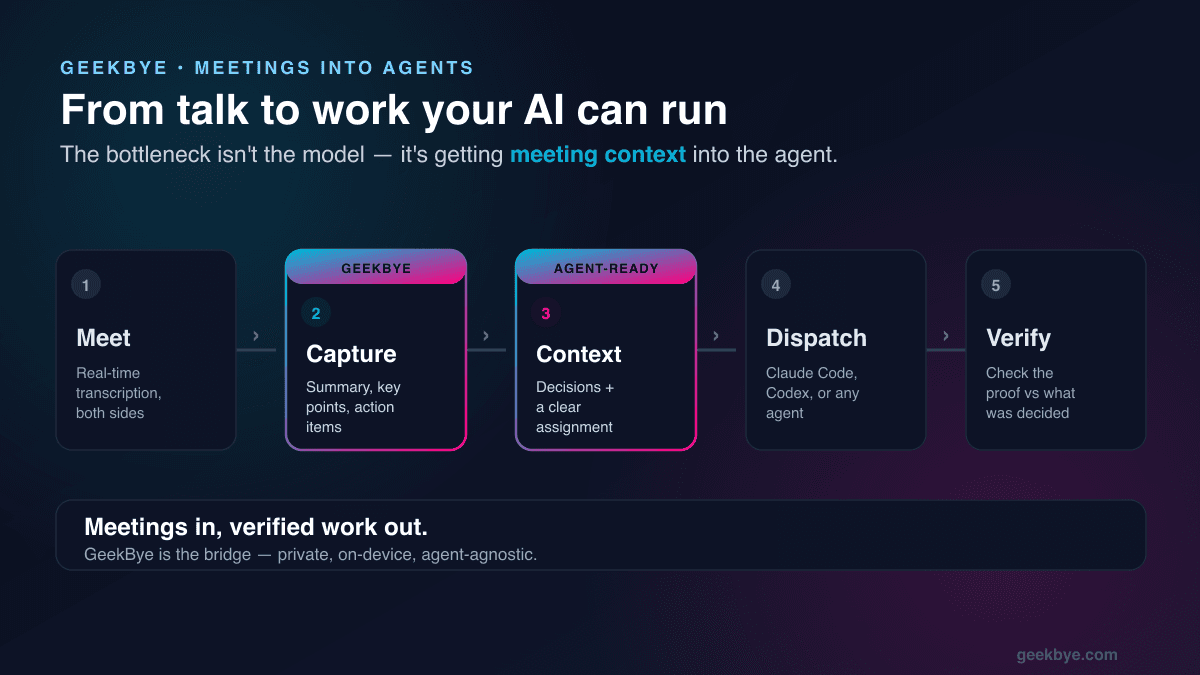
The practical workflow looks like this:
| Step | What happens |
|---|---|
| 1. Meet | GeekBye transcribes the call in real time, both sides |
| 2. Capture | It produces a summary, key points, and action items |
| 3. Assemble | You lift the decisions and requirements into a clear assignment |
| 4. Dispatch | You hand that context to Claude Code, Codex, or any agent |
| 5. Verify | The agent brings back work; you check it against what was actually decided |
That middle bridge — step 2 into step 3 — is the part that used to be manual, lossy, and slow. GeekBye makes it the easy part.
A simple playbook
You do not need a complicated system. Try this on your next project:
- Run your kickoff or planning call with GeekBye listening.
- After the call, open the summary and action items.
- Turn the top decision into a single, crisp assignment — goal, context, definition of done.
- Hand it to your agent of choice and ask for proof (a diff, a draft, a test).
- Check the result against the action items. Refine the assignment, not your memory.
Do that a few times and the habit clicks: meetings stop being where context goes to die, and start being the front end of your agent workflow.
FAQ
Do I have to be a developer for this to be useful? No. The same loop — capture a conversation, turn it into a clear assignment, hand it to an agent, verify the result — applies to research, writing, operations, and project work, not just code.
Why not just paste a raw transcript into the agent? You can, but raw transcripts are noisy and burn context. A summary with decisions and action items is denser and more accurate — the agent spends its attention on the work, not on parsing chit-chat.
Where does my meeting data go? With GeekBye, your library stays on your device. It is local-first with on-device processing, so the sensitive context you are feeding your agents does not become someone else's data.
Which agent should I use? Whichever fits the job — see Claude Code vs Codex for when to steer versus dispatch. GeekBye is agent-agnostic: it gives you clean context, you choose the tool.
The bottom line
The next leap in your productivity probably is not a smarter model. It is a shorter path from what was decided to what the agent does. Get practical about agentic tooling — clear assignments, real context, proof — and then stop letting your best context die in meetings. Capture it, structure it, and feed it straight into the agent.
That is the whole game: meetings in, verified work out.